Constituent Defining Attributes
Level 11
—
Oct 26, 2025
🚧 Content Planning
Initial research phase. Tools and protocols are being defined.
Obsidian Personal Knowledge Management Software
Obsidian Tour - The Best Knowledge Base & Note-Taking App · Latest Video
Strategic Rationale
For a 59-year-old, the concept of 'Constituent Defining Attributes' moves beyond simple identification to a sophisticated process of cognitive refinement, critical analysis, and precise articulation of complex concepts, systems, or ideas. It's about deepening understanding, challenging implicit biases, and applying this analytical skill to real-world problem-solving and communication. The chosen tool, Obsidian, a powerful personal knowledge management system, excels in providing the framework for this advanced developmental task. It allows the individual to:
- Deconstruct and Define: Explicitly break down complex concepts into their fundamental, inherent, and distinguishing properties, moving beyond superficial understanding.
- Build Semantic Networks: Create rich, interconnected knowledge graphs where the relationships between concepts and their attributes are clearly visualized, fostering a holistic and nuanced understanding.
- Encourage Metacognition: The act of externalizing, linking, and continually refining conceptual definitions promotes reflection on one's own thought processes and knowledge structure, leading to greater intellectual agility and adaptive expertise.
- Support Continuous Learning: Its flexibility allows for the integration of new information, ideas, and perspectives, ensuring that conceptual definitions remain dynamic and robust as the individual's knowledge evolves.
Implementation Protocol for a 59-year-old:
- Vault Setup & Core Concepts: Begin by setting up an Obsidian 'vault.' Choose a few complex, personally relevant concepts (e.g., 'Justice,' 'Artificial Intelligence Ethics,' 'Personal Legacy,' 'The Future of Work') that are important in your professional or personal life. Create a dedicated note for each.
- Initial Brainstorm & Attribute Extraction: In each concept's note, brainstorm all ideas, facts, feelings, and associations that come to mind. Then, critically review this list, separating mere associations or classifications from what you consider to be its constituent defining attributes – the inherent, distinguishing, non-relational properties that make the concept what it is. For example, for 'Justice,' an attribute might be 'impartiality,' not 'legal system' (which is a context).
- Atomic Attribute Notes: For each identified constituent attribute, create a separate, 'atomic' note (e.g.,
[[Impartiality]]). In this new note, provide a precise definition of the attribute, explain why you consider it a constituent attribute of the parent concept, and link it back to the original concept using[[Concept Name]](e.g., 'Impartiality is a constituent attribute of [[Justice]]'). - Connect & Contextualize: Utilize Obsidian's bi-directional linking to connect these attribute notes to other relevant concepts, notes, and sources (articles, books, discussions). Explore the 'Graph View' to visually understand the interconnectedness of your knowledge and identify any gaps or redundancies in your definitions.
- Iterative Refinement & Application: Regularly revisit your concept and attribute notes. Challenge your definitions, especially in light of new information or experiences. Use this refined understanding to analyze real-world problems, articulate arguments more precisely, or deepen your grasp of complex subjects. For instance, when encountering a new ethical dilemma, explicitly break it down by defining the constituent attributes of the conflicting values involved.
Primary Tool Tier 1 Selection
Obsidian Interface Screenshot
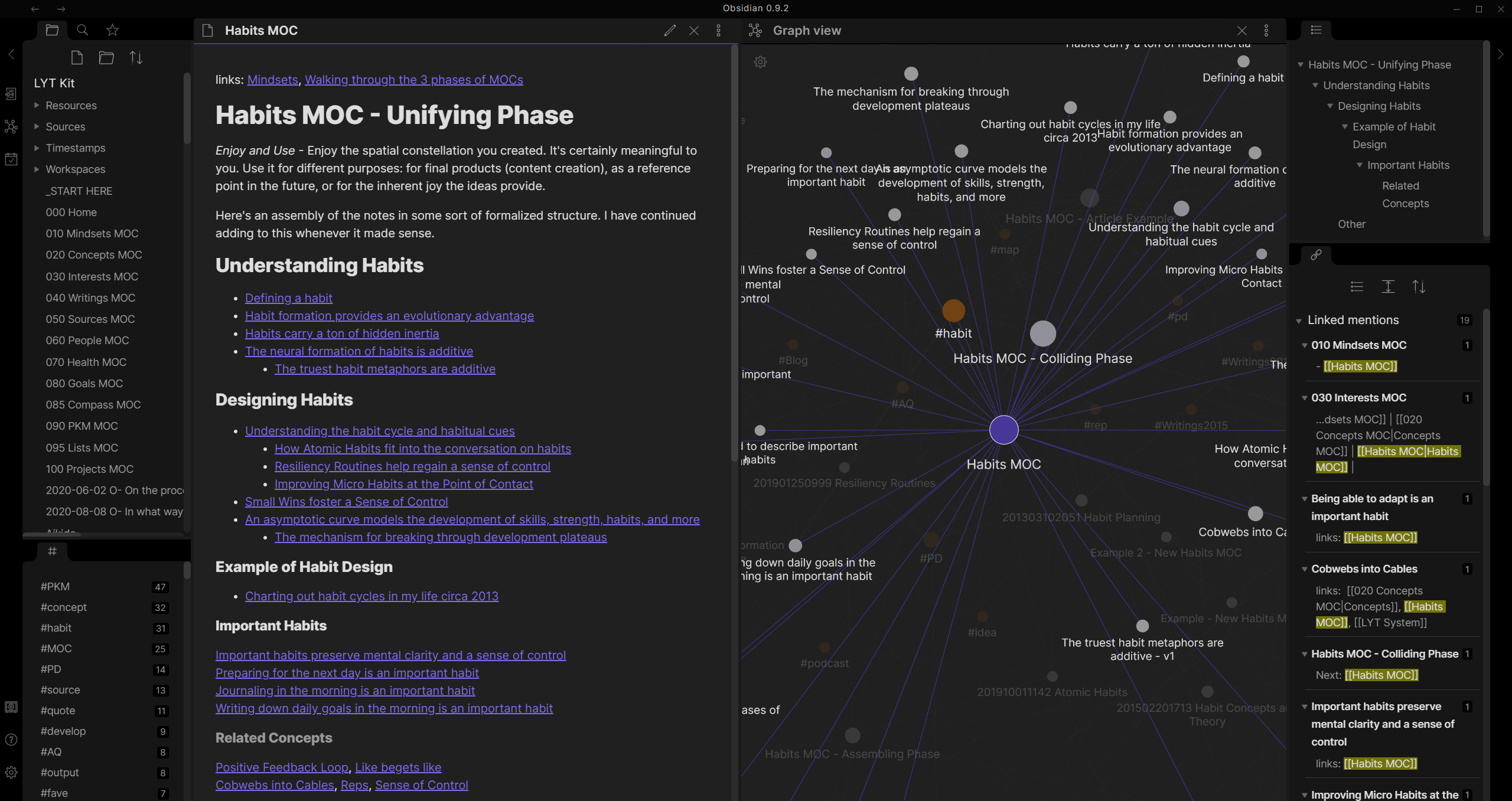
Obsidian is unparalleled for fostering the rigorous, structured thinking required to identify and define 'Constituent Defining Attributes' at this developmental stage. Its core strength lies in its ability to allow users to create a 'second brain' – a personal knowledge graph built on local Markdown files. This promotes deep conceptual decomposition by encouraging atomic notes for individual attributes, explicit linking to parent concepts, and the visualization of semantic networks through its powerful graph view. This process directly engages the cognitive skills of a 59-year-old in refining their existing knowledge base, challenging assumptions, and articulating complex ideas with precision. The software's flexibility allows it to adapt to any intellectual pursuit, making it a lifelong tool for cognitive development and maintaining intellectual agility.
Also Includes:
- Obsidian Sync (Paid Service) (8.00 EUR)
- Course: Linking Your Thinking (LYT) by Nick Milo (599.00 EUR)
- Ergonomic Mechanical Keyboard (e.g., Keychron K2) (99.00 EUR)
- Large High-Resolution Monitor (e.g., Dell UltraSharp U2723QE) (500.00 EUR)
DIY / No-Tool Project (Tier 0)
A "No-Tool" project for this week is currently being designed.
Complete Ranked List4 options evaluated
Selected — Tier 1 (Club Pick)
Obsidian is unparalleled for fostering the rigorous, structured thinking required to identify and define 'Constituent D…
DIY / No-Cost Options
A web-based personal knowledge management tool known for its block-based editor and powerful bi-directional linking and graph database approach. Emphasizes daily notes and outlines.
While excellent for network thinking and knowledge organization, Roam Research's block-based nature and emphasis on daily notes can sometimes diffuse the direct focus on meticulously defining and isolating 'Constituent Defining Attributes' compared to Obsidian's file-based, atomic note structure. It's also a subscription-only service without a free tier.
A collaborative online whiteboard platform designed for visual collaboration, brainstorming, and diagramming. Supports various templates for mapping and structuring ideas.
Miro is a fantastic tool for brainstorming and visually organizing ideas, which can support the initial stages of identifying attributes. However, it lacks the deep, structured linking, persistent knowledge graph capabilities, and atomic note-taking focus of Obsidian, making it less ideal for the rigorous, long-term refinement and re-evaluation of 'Constituent Defining Attributes' as a dedicated developmental tool for this specific topic.
An open-source ontology editor and framework for knowledge modeling. Used to define ontologies, which are formal representations of knowledge as a set of concepts within a domain and the relationships between those concepts.
Protégé is technically precise for defining conceptual attributes and relationships, aligning perfectly with the topic. However, its steep learning curve, highly technical interface, and academic orientation make it overkill and potentially overwhelming for a personal developmental tool for a 59-year-old. The goal is cognitive development through practical application, not becoming an ontology engineer.
What's Next? (Child Topics)
"Constituent Defining Attributes" evolves into:
Compositional/Structural Attributes
Explore Topic →Week 7187Intrinsic Qualitative Properties
Explore Topic →This dichotomy separates the rapid, often automatic, identification and utilization of conceptual patterns based on the inherent physical or conceptual components, parts, or elemental composition that constitute a concept (e.g., 'a bird has feathers', 'water is H2O', 'a car has an engine') from the rapid, often automatic, identification and utilization of conceptual patterns based on the concept's inherent, non-compositional descriptive qualities, characteristics, or nature (e.g., 'happiness is a subjective state of well-being', 'ice is cold', 'glass is transparent'). These two categories comprehensively cover the scope of how constituent defining attributes are implicitly identified and activated, distinguishing whether the focus is on the concept's constituent elements or its intrinsic descriptive properties.