Dynamic Interactional Processes
Level 6
—
Oct 25, 2025
🚧 Content Planning
Initial research phase. Tools and protocols are being defined.
LEGO DUPLO Classic Deluxe Brick Box (10914)
LEGO DUPLO: Play and Learn with Bricks · Latest Video
Strategic Rationale
At 21 months (92 weeks), a child's understanding of 'Dynamic Interactional Processes' is emerging through concrete, reciprocal engagements. The focus is on foundational social skills like turn-taking, joint attention, social referencing, and early cooperation, which are precursors to more complex social dynamics. The LEGO DUPLO Classic Deluxe Brick Box (10914) is globally recognized as the best tool for fostering these skills at this age due to its open-ended nature and inherent encouragement of shared activity.
Why it's World-Class for a 21-month-old on this topic:
- Reciprocal Engagement & Turn-Taking: DUPLO bricks naturally lend themselves to shared building. An adult and child can take turns adding blocks, exchanging pieces, and responding to each other's additions, creating a dynamic back-and-forth interaction. This directly cultivates the understanding of 'my turn, your turn' in a tangible way.
- Joint Attention & Social Signaling: As they build together, both individuals are focused on a common goal (the growing structure) and the shared materials. This encourages joint attention, where they point, gesture, make eye contact, and vocalize to communicate ideas or ask for specific pieces. This is crucial for developing social signaling skills.
- Imitation & Early Cooperative Play: The adult can model building techniques or specific structures, which the child can imitate. More importantly, the act of constructing something together, even if simple (like a tower or a car), is a fundamental form of early cooperative play, where their actions combine to create a shared outcome. The large, easy-to-handle bricks reduce frustration, allowing the child to focus on the social exchange rather than fine motor challenges.
Implementation Protocol for a 21-month-old:
- Setting the Stage: Sit facing the child with the DUPLO bricks easily accessible to both. Start with a relatively small selection of bricks to avoid overwhelm.
- Model & Narrate Turn-Taking: Begin by building a simple structure, narrating your actions: "My turn! I'll put the big red block on top. Now it's your turn! What block will you choose?" Offer a piece to the child.
- Facilitate Joint Attention: Point to specific bricks, the evolving structure, or the child's block, saying things like "Look! We're building a tall tower!" or "I see you have a blue one! Where should it go?"
- Encourage Social Signaling: Respond enthusiastically to the child's gestures, sounds, or words. If they point, ask, "Do you want this one?" If they hand you a block, say "Thank you for sharing!" Model asking for blocks yourself: "May I have a yellow block, please?"
- Simple Cooperation: Suggest small, achievable collaborative goals, like "Let's make a house for the doggy" or "Can we make a long train together?" Avoid imposing complex building plans; let the child lead often, following their interests while subtly guiding the interaction.
- Problem-Solving & Influence: If a tower falls, model a calm reaction and suggest, "Oh no! Let's try again. Maybe we can put a bigger block on the bottom this time?" This teaches resilience and gentle influence in problem-solving.
- Keep it Playful & Brief: Follow the child's lead. Keep sessions short (5-10 minutes) to maintain engagement and positive association with shared play. The goal is positive interaction, not perfect construction.
Primary Tool Tier 1 Selection
LEGO DUPLO Classic Deluxe Brick Box 10914
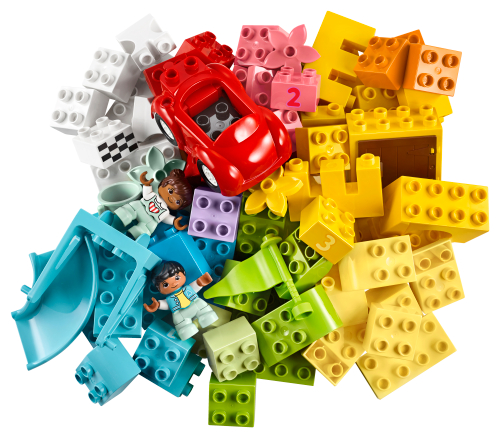
This DUPLO set is ideal for a 21-month-old's development of 'Dynamic Interactional Processes' because it offers a versatile collection of large, easy-to-handle bricks and figures that naturally facilitate shared play. Its open-ended nature allows for flexible, collaborative building, directly encouraging reciprocal exchanges, turn-taking, and joint attention. The inclusion of figures and numbered bricks adds layers for imaginative play and early counting, further enhancing social communication and cognitive development within interactional contexts. The large size ensures safety and reduces frustration, allowing the child to focus on the social dynamic.
Also Includes:
- LEGO DUPLO Compatible Storage Box (15.00 EUR)
- Child-Safe Toy Cleaning Spray (e.g., eco-friendly, non-toxic) (8.50 EUR) (Consumable) (Lifespan: 4 wks)
DIY / No-Tool Project (Tier 0)
A "No-Tool" project for this week is currently being designed.
Complete Ranked List3 options evaluated
Selected — Tier 1 (Club Pick)
This DUPLO set is ideal for a 21-month-old's development of 'Dynamic Interactional Processes' because it offers a versa…
DIY / No-Cost Options
A modular wooden ball track system where children can assemble tracks and release balls, observing gravity and cause-and-effect.
While excellent for joint attention and understanding cause-and-effect (precursors to understanding social influence), the building complexity of the HABA Kullerbü system can be high for a 21-month-old, requiring significant adult scaffolding. The 'dynamic interactional processes' it facilitates tend to focus more on shared observation of the ball's movement rather than the direct, reciprocal social signaling and negotiation that DUPLO encourages during shared construction. It's a fantastic tool, but less potent for explicitly fostering reciprocal social cues at this specific age than DUPLO.
Classic wooden building blocks of various shapes and sizes for open-ended construction.
Wooden unit blocks are superb for open-ended collaborative building and fostering creativity, which can certainly involve dynamic interaction. However, for a 21-month-old, the lack of interlocking mechanisms (compared to DUPLO) can lead to more frustration with collapsing structures, potentially shifting the focus from social interaction to managing the physical challenges of balancing blocks. DUPLO's interlocking design provides more stability, allowing the child and caregiver to more smoothly engage in reciprocal social exchanges without constant rebuilding, making it more potent for the 'dynamic interactional processes' at this developmental stage.
What's Next? (Child Topics)
"Dynamic Interactional Processes" evolves into:
Shared Meaning and Social Understanding Processes
Explore Topic →Week 220Behavioral Influence and Outcome Coordination Processes
Explore Topic →All dynamic interactional processes can be fundamentally divided into those primarily focused on establishing, conveying, and interpreting shared meaning, symbols, and social understanding among participants, and those primarily focused on actively influencing others' behaviors, states, or coordinating actions to achieve collective or interdependent outcomes. This dichotomy distinguishes between the interpretive and communicative aspects of interaction and the action-oriented, consequential aspects, ensuring mutual exclusivity and comprehensive exhaustion.