Exploring Quantum Gravity and Unification Theories
Level 9
—
Oct 25, 2025
🚧 Content Planning
Initial research phase. Tools and protocols are being defined.
The Fabric of the Cosmos: Space, Time, and the Texture of Reality by Brian Greene
What is Brilliant? Official Explainer Video · Latest Video
Strategic Rationale
The selected tools provide a comprehensive, age-appropriate, and highly engaging pathway for a 17-year-old to explore 'Quantum Gravity and Unification Theories.' Brian Greene's 'The Fabric of the Cosmos' offers an unparalleled conceptual foundation, expertly weaving together the core principles of Special and General Relativity and Quantum Mechanics, and then introducing the challenges and leading theories of unification (like String Theory) in an accessible yet profound manner. This book acts as the primary conceptual guide, fostering abstract thinking and scientific literacy. Complementing this, a Brilliant.org Premium subscription provides interactive, problem-solving-based learning experiences through its 'Relativity' and 'Quantum Mechanics' courses. This active engagement is crucial for solidifying foundational understanding and developing the analytical skills necessary to approach such advanced topics. Together, these tools empower a motivated 17-year-old to independently delve into the frontiers of physics, laying robust groundwork for future academic pursuits in theoretical physics.
Implementation Protocol:
- Phase 1: Conceptual Immersion (Weeks 1-8): Begin with 'The Fabric of the Cosmos.' Encourage the student to read at their own pace, focusing on understanding the core concepts of Special and General Relativity (Chapters 1-5) and Quantum Mechanics (Chapters 6-9). Encourage active reading, note-taking, and formulating questions.
- Phase 2: Interactive Foundation Building (Weeks 3-16): Concurrently with or immediately following Phase 1, start the Brilliant.org 'Relativity' and 'Quantum Mechanics' courses. Dedicate specific time slots (e.g., 2-3 hours/week for each course) to work through the interactive lessons and problems. Use the platform to reinforce and deepen understanding of concepts introduced in the book, focusing on the mathematical reasoning and problem-solving aspects.
- Phase 3: Exploring Unification (Weeks 9-20+): Return to 'The Fabric of the Cosmos' for the later chapters discussing String Theory, M-Theory, and the challenges of quantum gravity. At this stage, the student will have a much stronger grasp of the foundational theories, making the more speculative and complex unification theories more comprehensible. Encourage critical thinking about the different approaches and the open questions in the field.
- Phase 4: Deeper Dive & Discussion (Ongoing): Encourage the student to seek out reputable online lectures (e.g., from academic institutions, TED Talks by physicists), documentaries, or introductory articles from scientific magazines (e.g., Scientific American, New Scientist) related to specific aspects of quantum gravity (e.g., Loop Quantum Gravity, black hole information paradox). Facilitate discussions to explore their understanding and questions.
Primary Tools Tier 1 Selection
Book Cover of The Fabric of the Cosmos
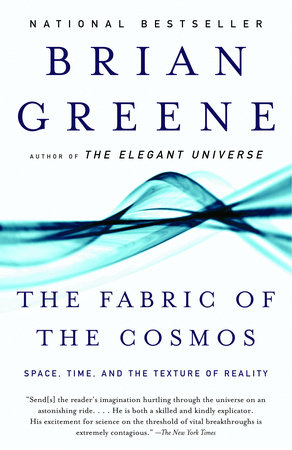
This book is unparalleled for a 17-year-old interested in quantum gravity. Brian Greene is a master at making highly complex physics concepts—from Special and General Relativity to Quantum Mechanics and String Theory—accessible and engaging without oversimplification. It provides a comprehensive conceptual framework essential for 'exploring' quantum gravity and unification, acting as an excellent bridge between popular science and introductory university physics. It systematically builds the foundational understanding of spacetime, quantum phenomena, and the universe's structure, which are prerequisites to truly grasp the challenges and theories of quantum gravity. It's challenging but immensely rewarding for a curious and bright mind at this developmental stage.
Also Includes:
- High-Quality Notebooks (e.g., Leuchtturm1917 or Moleskine) (15.00 EUR) (Consumable) (Lifespan: 12 wks)
- Set of Fine-Point Pens and Highlighters (20.00 EUR) (Consumable) (Lifespan: 52 wks)
Brilliant.org Logo
Brilliant.org offers an interactive, problem-solving-based learning platform that beautifully complements theoretical reading. For a 17-year-old exploring quantum gravity, it's essential to solidify the foundational concepts of quantum mechanics and relativity through active engagement. The 'Relativity' and 'Quantum Mechanics' courses, in particular, offer a clear, step-by-step, visually rich approach to complex ideas, allowing the student to build intuition and solve problems, which is critical before delving into the unification challenges. The gamified and interactive nature keeps a 17-year-old highly engaged in self-study, reinforcing the mathematical and conceptual muscles needed to tackle advanced physics topics.
DIY / No-Tool Project (Tier 0)
A "No-Tool" project for this week is currently being designed.
Complete Ranked List5 options evaluated
Selected — Tier 1 (Club Pick)
This book is unparalleled for a 17-year-old interested in quantum gravity. Brian Greene is a master at making highly co…
Brilliant.org offers an interactive, problem-solving-based learning platform that beautifully complements theoretical r…
DIY / No-Cost Options
An intensive, university-level online course covering the fundamentals of quantum mechanics, offered by MIT.
While offering exceptional rigor and depth, this course is likely too mathematically intensive and demanding for a 17-year-old's initial 'exploration' of quantum gravity. It requires a strong background in linear algebra and differential equations, which might exceed the scope of even an advanced high school curriculum, making it less effective as an initial broad exploratory tool. It would be an excellent follow-up for a student who has mastered the foundational concepts.
A classic undergraduate textbook providing a comprehensive introduction to General Relativity.
This textbook is highly regarded and mathematically rigorous for General Relativity, which is a critical component of quantum gravity. However, for a 17-year-old, it would likely be too dense and mathematically challenging for a first exposure, especially without concurrent instruction or a strong existing physics/math background. It focuses solely on GR and doesn't integrate QM or directly address unification theories, making it less holistic for 'exploring quantum gravity and unification theories' at this age.
A popular science book exploring the many-worlds interpretation of quantum mechanics and its implications for spacetime.
This book is excellent for conceptual understanding of quantum mechanics and spacetime, and Sean Carroll is a superb communicator. However, it focuses heavily on a specific interpretation of QM (Many-Worlds) and its implications, rather than broadly covering the spectrum of quantum gravity and unification theories. While valuable, it is less comprehensive in its 'exploration' of the broader topic compared to Brian Greene's 'The Fabric of the Cosmos' for a 17-year-old seeking a wider overview.
What's Next? (Child Topics)
"Exploring Quantum Gravity and Unification Theories" evolves into:
Quantum Geometry and Background-Independent Gravity
Explore Topic →Week 1954Unified Field Theories and Emergent Gravity Models
Explore Topic →"Quantum Geometry and Background-Independent Gravity" focuses on approaches that attempt to quantize the structure of spacetime itself, often without assuming a fixed background, and exploring the discrete or emergent nature of space and time (e.g., Loop Quantum Gravity, Causal Dynamical Triangulations). "Unified Field Theories and Emergent Gravity Models" encompasses theories that aim to provide a single, consistent framework for all fundamental forces and matter, where gravity arises as an emergent property from more fundamental degrees of freedom or a higher-dimensional structure, typically within a background-dependent context (e.g., String Theory, M-Theory). These two categories represent distinct philosophical and methodological paths in the quest for quantum gravity and grand unification.